LEGO Fabuland History: From 1979 Through Its Final Year in 1989
Written by Bik Brik Editor with AI assistance and automated fact checks. Editorial policy
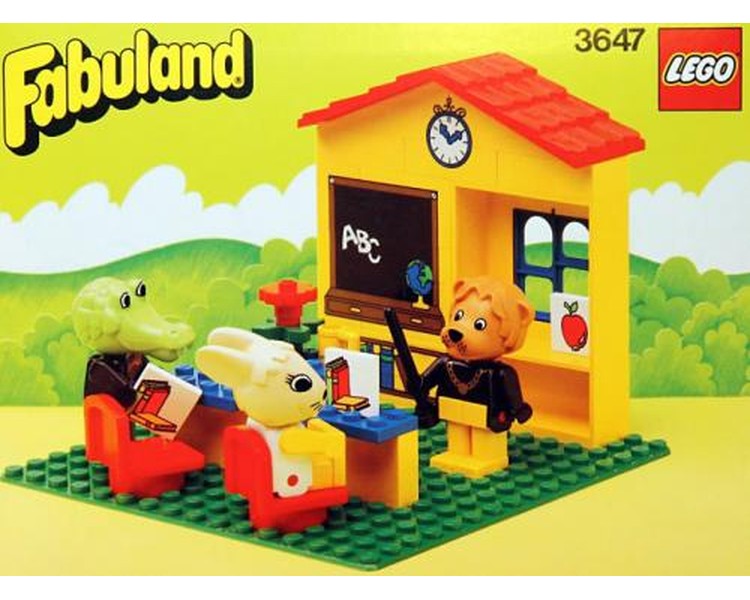
LEGO Fabuland ran from 1979 through 1989, building a distinctive world around animal characters and familiar everyday settings. Its later releases included classrooms, kitchens, recreational attractions and small vehicles, offering collectors a useful way to explore how the theme maintained its identity through its final years.
Key facts
- Theme
- Fabuland
How did Fabuland develop over its lifetime?
Fabuland occupied a distinct decade in LEGO history, beginning in 1979 and reaching its final year in 1989. Its identity came from combining animal characters with recognizable everyday environments. Rather than centering on large buildings or elaborate adventures, the theme explored familiar activities and places, giving its products a recognizable character of their own.
One example from the earlier period is 3665-1 Harry Horse and Clara Cow's Ice Cream Shoppe, a 39-piece release from 1980. Its subject illustrates how an ordinary commercial setting could become part of the Fabuland world. Looking at the theme as a whole, its decade-long run provides collectors with a clearly defined historical period. The connection between characters, everyday activities and compact environments is central to understanding what distinguished Fabuland from other LEGO themes.
What made the later Fabuland sets distinctive?
The 1988 releases demonstrate the range of settings explored by Fabuland. 3622-1 Rowboat contains 14 pieces, while 3623-1 Beauty Salon has 26 and 3646-1 Kitchen has 56. These subjects brought different everyday activities into the theme, extending its world beyond a single type of setting.
A larger example is 3683-1 Amusement Park, with 100 pieces, making it the biggest set by piece count among the 1988 examples discussed here. 3680-1 Camping Caravan contains 31 pieces, while 3721-1 Clive Crocodile on Skateboard has 13. Together, these products cover transportation, leisure and domestic life. For collectors, the contrast in scale and subject matter offers a useful snapshot of Fabuland's creative range during its later period. It also shows how the theme could accommodate both small character-focused releases and more substantial play environments.
What did the final year of Fabuland bring?
The year 1989 marks the end of Fabuland's timeline. Three representative releases from that year are 3647-1 School Room, with 47 pieces, 3663-1 Max Mouse's Carousel, with 26 pieces, and 3676-1 Catherine Cat's Fun Park, with 50 pieces. Their subjects continue the theme's emphasis on animal characters and familiar environments, including education and recreation.
These releases are interesting because they preserve the established Fabuland approach while exploring different locations within its fictional world. School Room introduces an educational setting, while the carousel and fun park extend its recreational side. Compared with the varied 1988 releases, the final-year group provides a useful reference point for understanding how the theme concluded. Collectors examining Fabuland chronologically can use these three sets to identify its closing chapter without losing sight of the design ideas that connected the wider range.
What does this mean for collectors?
For vintage LEGO collectors, Fabuland offers more than a clearly defined production period from 1979 to 1989. It represents a distinctive approach to character-based play, with animal figures and everyday environments providing a consistent identity across different releases. Organizing sets by year makes it easier to understand the theme's development and distinguish its earlier products from its final releases.
Collectors interested in an earlier example can examine 3665-1 Harry Horse and Clara Cow's Ice Cream Shoppe from 1980. For the closing period, 3647-1 School Room, 3663-1 Max Mouse's Carousel and 3676-1 Catherine Cat's Fun Park provide three representative 1989 entries. Their official names, set numbers and piece counts are useful reference points when organizing a collection or comparing related products. The 1988 releases add further variety, from the compact Rowboat to the larger Amusement Park. Taken together, these sets help explain Fabuland's historical identity through its subjects, scale and continuity of design, rather than through speculation about future resale values.
Frequently asked questions
When did LEGO Fabuland begin and end?
Fabuland began in 1979, and 1989 was its final year.
Which 1988 Fabuland example has the most pieces?
3683-1 Amusement Park has 100 pieces, the highest count among the 1988 examples discussed.
Which Fabuland sets represent its final year?
3647-1 School Room, 3663-1 Max Mouse's Carousel and 3676-1 Catherine Cat's Fun Park are all from 1989.
Related news
Comments
Comments are reviewed before they appear.